Saturday, July 23, 2022

An Interview With Myla Perkins Part 1 of 3

An Interview With Myla Perkins

Trailblazing Black-Doll Enthusiast, Doll Historian, and Author

by Debbie Behan Garrett

Myla Perkins, circa 1990

The author of Black Dolls an Identification and Value Guide 1820 to 1991 (Black Dolls) and Black Dolls an Identification and Value Guide Book II (Black Dolls Book II) granted this exclusive interview. Myla Perkins’ books continue to offer a wealth of information on antique, vintage, and modern Black dolls made from 1820 through the early 1990s. Her journey to become one of America’s most prominent and respected Black-doll enthusiasts, historians, and authors is explored in this in-depth interview.

Myla Perkins spent decades collecting and researching dolls, but her love of dolls dates back to her childhood. She had always liked dolls as a little girl. Born in Pueblo, Colorado in 1939, her family moved to Detroit, Michigan when she was seven after her parents sold the Colorado home and its contents. Her father moved to Detroit first. Six months later, the rest of the family followed. Before the mother and her daughters joined the girls’ father, Myla’s mother allowed them to only bring one thing on the two-day train trip. Myla brought her last doll, and her sister brought her doll. Both dolls were White. This was in the early 1940s, and Myla, like many Black children during that era, did not know Black dolls existed. Myla’s love of dolls began when her mother allowed them to bring their dolls to Detroit. She also recognized the importance of dolls at that time.

After the family moved to Detroit, young Myla still had that doll. For Christmas, she and her sister received many toys, but the dolls remained the most important gifts because of that one doll she brought from Colorado.

During her teen years, Myla's mother tried to persuade her to give her dolls to her younger cousins. She allowed her mother to give some away, but she kept the one she brought from Colorado hidden in her closet with the last doll she received at age 11. The dolls remained hidden until she married. After marrying, Myla’s mother still did not know she had those two dolls. She would have made her give them away if she had known. Myla explained, “I graduated from college at 21 in June and got married in July (we met in college). My husband laughed when I unpacked. Astounded, he asked, ‘What are these dolls?’’’ Two years later, after their first daughter was born, Myla gave her two childhood dolls to her daughter. She displayed the dolls that began her daughter’s collection on shelves in the infant's nursery. Myla began buying dolls for her daughter to add to the others. “I’ve always been interested in genealogy, by the time she was three or four, I thought, she has my dolls from my childhood, and she has her dolls. I want her to have a doll from the period of my mother’s childhood, the 1920s.”

A bisque doll made in Germany, circa 1900 by Simon & Halbig #1358 is featured on a Sugar ‘n Spice Doll Museum note card. (Myla referred to her doll collection as the Sugar 'n Spice Doll Museum.)


Myla began going to antique shops to find antique dolls from the 1920s for her daughter. The first ones she saw and purchased were White. Later during a search, she stumbled upon a Black Simon & Halbig doll in a shop. When she found that doll, all of a sudden something snapped. Myla realized she was not buying dolls for her daughter anymore; she was actually buying them for herself. That was a turnaround in her thinking.

In her first Black Dolls book, Myla wrote, “#1358, the most desired of the Simon & Halbigs because of its Negroid features, came in various shades from deep black to light brown in a size range from 15” tall to 34” tall…”

During the late 1960s, she became more involved with antique dolls, and she met doll artist/doll dealer Betty Formaz, who later discovered Leo Moss dolls. By this time, Myla had stopped buying antique White dolls in favor of antique Black dolls. Later, she joined the United Federation of Doll Clubs (UFDC), an organization that unites and organizes doll collectors around the world ("About UFDC").

Myla shared the following experience about joining UFDC:

“In the 1960s, UFDC in Detroit did not allow Black members. Betty Formaz was a member along with two or three of her other customers. She and the other members told UFDC, ‘Either you let Myla in, or we are all withdrawing our membership.’ So, [Betty Formaz] put herself on the line for me. There were about two or three others who did the same thing. So, UFDC did let me in and they were very nice, very gracious. The other women who threatened to withdraw their membership if UFDC did not allow me to join were part of our nucleus group.”

This group photograph of paper mâché dolls by Leo Moss from the 1800s and early 1900s is from the cover of a Sugar ‘n Spice Doll Museum note card.


According to Myla, Betty later discovered the Moss family in Macon, Georgia, and brought some Leo Moss dolls back to Detroit. After her first trip to Georgia, Betty returned with only five or six Moss dolls because that is all the family would allow her to bring back. Because the dolls were Black, Betty let Myla, her only Black customer, choose her favorite. Myla chose Mina, the doll in the Moss group photo above seated on the right, above the seated boy. The rest of the nucleus group purchased the other initial Moss dolls from Betty.

Perkins has delighted in meeting several wonderful doll collectors, artists, and others who were deeply involved in the doll community. While attending her first UFDC National Convention in 1973 in Louisville, Kentucky from August 1st through August 5th, she met the late Lenon Holder Hoyte. Mrs. Hoyte founded Aunt Len's Doll and Toy Museum in Harlem, New York. Before 1973, Hoyte had been the only Black person to attend UFDC national conventions. Hoyte and Perkins were happy to see one another the first year Myla attended. Myla recalled Hoyte asking her what she brought for the UFDC doll competition. “A doll from the turn of the century,” was Myla’s reply. Because she respected Hoyte, Myla took her to her room to see the doll after Hoyte asked to see it. When Hoyte looked at Mina, the Leo Moss doll, she voiced her displeasure stating that the doll was disgraceful! More unpleasant comments from Hoyte about Mina followed with an attempt to talk Myla out of entering the doll in competition. Second thoughts about entering the doll ensued before Myla discussed the situation with her husband by phone, who said, “She didn’t buy your plane ticket there. She is not paying for your hotel. Do what you want to do in your heart.” When Myla went down to enter Mina in the competition, she said, “Who did I see standing in line… Lenon looked at me [saw the doll] and asked, ‘You’re still doing that?’” Fortunately, for the doll community, Myla followed her heart and did just that.
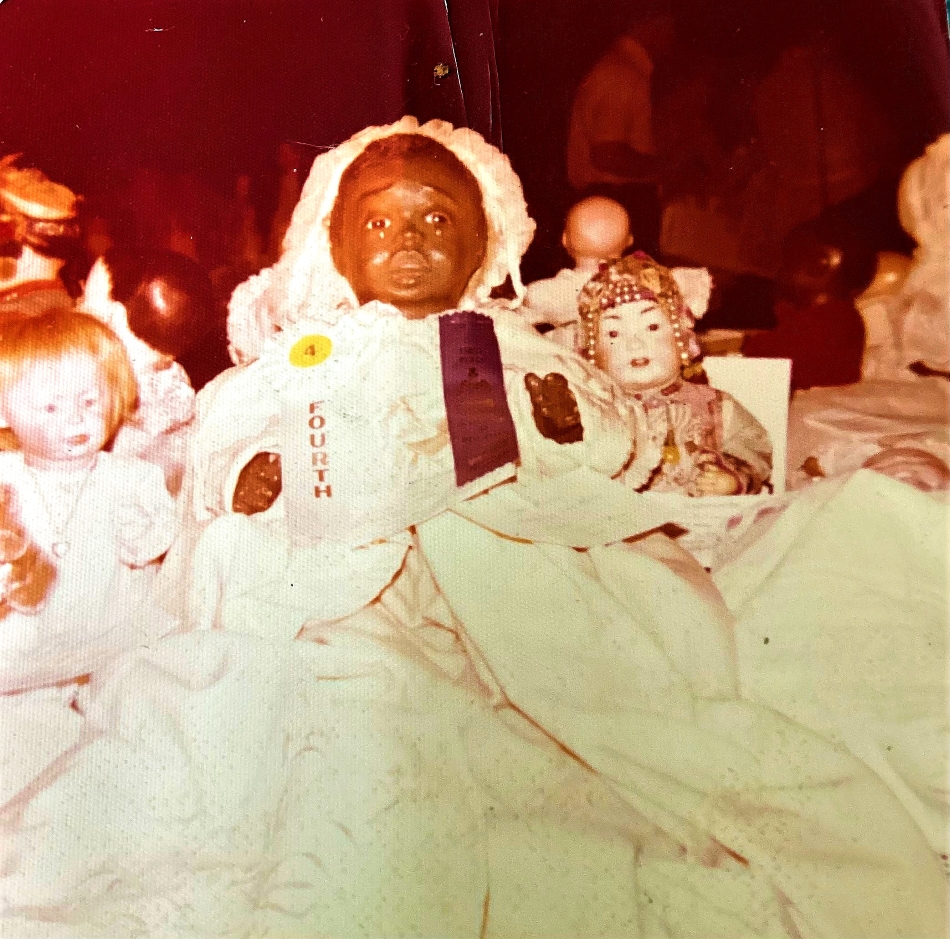

Mina was photographed at the UFDC 24th National Convention in August 1973 after winning 1st and 4th place ribbons.


Mina introduced Leo Moss dolls to the doll community after being entered in the baby doll category and winning a 1st place ribbon. After Mina placed first in the baby doll category, Myla said, “Lenon Hoyte was the first person in my room wanting to know where I got Mina, how did I get it, and how could she get something like it.” Myla documented Mina's UFDC convention wins in Black Dolls and indicated that Mina "was the first Leo Moss doll to win a ribbon in national competition" where "there were over 1,800 dolls" competing. During the interview, Myla shared that no other Black dolls were in competition at the convention that year.

After Mina won 1st place in the baby doll category and 4th best doll in the show, UFDC became interested in the doll and asked for more information about it. Myla shared a booklet she wrote about Leo Moss dolls with UFDC that was published in the Doll News issue that followed the convention (possibly the September 1973 issue). In 1973, Doll News was published monthly. It is now a quarterly publication.

Continue reading here.

An Interview With Myla Perkins Part 2 of 3


In an undated photograph, with dolls in the background and foreground, Myla stands holding Mina.

Continued from Part 1

During her UFDC membership, Myla attended every national and regional convention that followed the 1973 convention. For several years, Black UFDC conventioneers only included Myla Perkins and Lenon Hoyte. Perkins always took a Moss doll and a Moss doll always won 1st place. The only time one of her Moss dolls did not win 1st place was when someone else entered a Moss doll and the other doll placed first. The year that happened, her doll, a smaller Moss doll, won 2nd place. It did not matter to Myla that her doll placed second because another Moss doll still placed first. Nineteenth-century dolls made by a Black man described as a handyman from Macon, Georgia continue to intrigue and fascinate the doll community today. Myla eventually owned several.


Myla is seen in another undated photograph with Leo Moss dolls, Mina, Bobo, and Pansy.


Myla’s love for antique dolls continued. Once she realized there were Black dolls made during her childhood, she became interested in those. Upon learning that Myla collected dolls, one of her aunts, who was also born in Colorado, told Myla she had a Black doll in the 1930s that was ordered in a beauty shop. During that time, beauty shops offered brochures for ordering Black dolls. Myla could not recall which doll her aunt owned, but she knows it is documented in one of her books. After learning about her aunt’s doll, Myla began looking for other Black dolls from the 1930s, ‘40s, or ‘50s. By this time, she was obsessed with Black dolls—who they were made for, why they were made, and where they were distributed.

A lucky girl named Mabel Parchman posed with her doll from R. H. Boyd’s National Negro Doll Company in a photograph published in the Nashville Globe on April 11, 1913. 

            Myla’s vast doll collection included antique dolls by R. H. Boyd’s National Negro Doll Company, which Mr. Boyd founded in 1911 after recognizing the need for respectable Black dolls for his children and others. The former enslaved man's story fascinated Myla. “Boyd’s eyes were open wide,” she said. During her doll research, at one point she spoke with one of Boyd’s daughters, but the daughter was not receptive to Myla and did not want to talk to her. “Some of us get a little off track,” Myla said. According to Myla, the daughter almost tried to deny that Boyd’s early 1900s dolls existed, but Myla asserted that his dolls were in The Crisis magazine, as illustrated in the next image, and she could not deny what her father did. Several people closed doors in Myla’s face. “People are still doing it,” she said. “There are some people who still believe White folk’s ice is colder,” she added. 

"The Crisis magazine is the official publication of the NAACP. It was created in 1910 by renowned historian, civil rights activist, sociologist, and NAACP co-founder W. E. B. Du Bois (“History of the Crisis”).

In Black Dolls Book II, Myla included this National Negro Doll Company ad that was placed in The Crisis in November 1911.

During the years Myla collected dolls and purchased dolls for her children, she witnessed a slight improvement in the availability of modern Black dolls. In the 1960s, finding Black dolls in stores for her first daughter, who was born in 1962, was difficult. To combat this issue, Myla met with buyers for large department stores and put a lot of pressure on them because they did not carry Black dolls. By the mid-1970s, she did not experience as much difficulty finding Black dolls for her second daughter who was born in 1969. Black dolls were not as limited by then, but the scarcity remained. 

Myla’s daughter’s Baby Alive by Kenner, 1973, is featured in Black Dolls Book II.


“I remember when she was four, she wanted Baby Alive. I looked all over ahead of time and couldn’t find the Black Baby Alive. So, I wrote her a note addressed to Santa stating that by the time her birthday came in June, Santa would be able to find her Baby Alive. I had to play games with my kids,” Myla shared. When Cabbage Patch dolls first came out in the early 1980s, Myla said the dolls were in Detroit, but Black versions were the first ones to sell out. She had to rush to get Black Cabbage Patch dolls because the demand exceeded the supply. 

Perkins’ enthusiasm over Black dolls prompted her to actually begin writing the first Black Dolls book during the 1970s. The original manuscript included all the dolls made by 1975. Her husband photographed the antique dolls. One of her good friends, Susan Manos, had written a Barbie book published by Schroeder Publishing Company, and they also wanted to publish Myla’s book. By 1975, Myla was busy with family and work life as a teacher and co-owner of Sugar ‘n Spice day care center and private elementary school. She had four children who were born within seven years and life was hectic. Schroeder published another book on Black dolls around the same time, Collector’s Encyclopedia of Black Dolls by Patiki Gibbs. So, when that book was released, Myla reasoned, “There’s already a book on Black dolls, and I just let that go. Everything just sat in boxes.”

Published in 1991 and 1995, respectively, Black Dolls an Identification and Value Guide 1820-1991 and Black Dolls an Identification and Value Guide Book II are must-have resources for collectors of Black dolls and anyone with the slightest interest in them.


By 1987, Myla’s youngest child had graduated high school and had gone to college. She and her husband were empty nesters for the first time. In 1988 or 1989, she thought about her unpublished book and contacted the publisher. “They remembered me, still wanted me to write the book, and asked me to please send the information,” Myla recalled. At that point, she updated the manuscript with newer dolls from the 1980s and 1990s. 

 After writing and publishing her first book, in 1994, Perkins founded Motor City Doll Club (MCDC)—Detroit’s first Black-doll club. MCDC achieved charter membership in UFDC in 1995. Myla is no longer an MCDC or UFDC member. When she left the doll world, she closed that chapter of her life completely.

If she had the opportunity to restart her collecting/doll historian journey and do anything differently, she said would not. She enjoyed collecting, enjoyed the friends she met along the way, and she remembered talking to me during the late 1990s after the late Patricia Tyson (former owner of Cultural Accents in Detroit) encouraged me to call Myla. At that time, Myla was selling some of her dolls. Among a few others, I purchased some career-inspiring dolls called Wanna-Be created by the corporation of the same name.  Dolls in the series included male and female pilots, doctors, teachers, executives, firefighters, soldiers, a male football player, and a female cheerleader.

During the mid-1990s, I purchased Wanna-Be males from Myla that represent an executive, a doctor, a football player, and one female that represents a pilot.


 Continue reading here


An Interview With Myla Perkins Part 3 of 3

In a photograph courtesy of Michigan State University Museum, Myla Perkins and her sister, standing on the far right, are seen with the other members of The Quilting Six.

Continued from Part 2

For Myla, collecting slowed down due to an issue many veteran collectors face, the lack of display space. Her interest in dolls was also fading. She liked the dolls she had, but she did not want to add any more. By 1992, God had blessed her with two more living dolls—her first two granddaughters. Five more granddaughters and a grandson followed. She also now has two great-granddaughters. As a result, Myla became increasingly focused on her family. “I have a second hobby. I quilt, and quilting takes up as much time as doll collecting,” Myla shared.

While quilting also requires time, it became more gratifying than doll collecting. It allows Myla to use the sewing skills she learned as a child and honed over the years. Two years before her oldest child went to college, Myla’s friends told her about care packages they sent to their college children. Myla admitted, "I have done a lot of things, but I never really loved cooking. I decided I would not cook food, pack it up and mail it because it would not be good when it left Detroit, and it would not be good when it got to where it was going." She decided to make a quilt so when her daughter’s roommate received care packages, “she could wrap herself in a quilt I made and cry because she did not get a care package.” Her then high school daughter encouraged Myla to start working on the quilt so it would be ready before she went to college. She realized she really liked quilting and has continued to quilt since the mid-1970s. A quilt of doll dresses made approximately 20 years ago is her only doll-related quilt.


"Underground Railroad" by Myla Perkins

Myla and a group of sorority sisters and friends formed The Quilting Six. The six members are featured in a photograph on the Quilt Index website, “an open access, digital repository of thousands of images, stories and information about quilts and their makers” (Overview). Photographs and details of two quilts Myla made, “Underground Railroad” from 1984 and “Bridal Wreath” from 1985 are included in her Quilt Index profile.

As Myla’s focus shifted away from collecting, she focused on selling the dolls.  Her Leo Moss dolls were the last dolls she parted with and doing so was not difficult at all for her. The dolls had been on display at the Charles H. Wright Museum of African American History in Detroit before she gave her entire doll collection to her oldest daughter to sell. At that point, Myla had a decision to make regarding the dolls—either she would give the dolls to a museum or she would allow her daughter to sell them. Her final decision was based on knowing too many people who gave things to museums and the museums kept them in storage in basements. Either rodents got them, bugs got them, or humidity destroyed them. Myla shared that she curated a doll collection for a museum that kept the collection in their basement and never did display it. She did not want any of this to happen to her dolls. Furthermore, she did not want the collection improperly disposed of as has happened to many other collectors’ dolls. She wanted people to enjoy them.


Myla's impressive collection was displayed in her home in special cabinets.


Myla added, “When something is past its time, I am willing to let it go and move on. A lot of people were surprised that I even sold them. My husband and I had lived in our home for 41 years where we raised our four children. That’s where I collected all my dolls. My husband had special cabinets built for them. When I moved from that house 13 years ago, selling the house to my son, I left the dolls there. I took what I wanted. I didn’t have room for them. My son was alright [about the dolls being there] since he grew up with them.” Eventually, Myla decided to move the dolls all out, sell them, and move on.

After receiving the Moss dolls back from the Wright Museum and several other antique Black dolls, Myla gave her daughter a list of national auction houses to contact. Her daughter chose Theriault’s. Theriault’s took all the Moss dolls, a total of 13, and some of the other antique dolls to auction. On March 17, 2018, Myla’s Moss dolls and other antique dolls were auctioned by Theriault’s in the quite successful “Tears for Mina” auction.

A doll that represents King Tut by Averill Manufacturing Co. is seen in a photograph from Black Dolls Book II.

One doll that Myla regrets giving her daughter to sell is the King Tut (U-Shab-Ti” Tutankhamen) doll by Averill Manufacturing Co. made in 1923. “It was totally original and was made the year they discovered his tomb,” Myla shared. Tutankhamen, more commonly referred to as King Tut or Boy King, was the King of ancient Egypt from about 1347 to 1339 B.C. He was only eight or nine years old when he became king.

In answering interview questions about the late doll artist, I. Roberta Bell, who was the first African American member of the National Institute of Doll Artists, Myla described her as a lovely person. She owned several of Ms. Bell’s dolls made in the likeness of historical African Americans. “Bell’s work and Hoyte’s museum enriched the doll community in different ways,” Myla related. We discussed Barbara Whiteman’s annual Memorial Day weekend Philadelphia Doll Shows that were held from the late 1980s until 2012. Myla recalled how grand the early shows were with workshops, lectures, Black doll artists, and many activities for collectors to enjoy.

Myla’s advice to novice collectors is to take care of the dolls they collect, and "don’t try to redo them." She feels that changing the dolls in any way diminishes their value. “You can refurbish antique cars and they maintain their value, but I don’t think you should do that to dolls.” She also encourages collectors to share their dolls with museums and with others in the community through displays and exhibitions.

Myla Perkins today

Myla ended the interview by affirming, “I don’t mind you sharing my age. I’m 83 and feel blessed to still be here and healthy.”

The doll community is also blessed because Myla Perkins shared her dolls and doll research in the form of booklets, books, exhibitions, and community and media appearances.  She founded Detroit’s first Black-doll club, became Detroit’s first UFDC Black member, and introduced Leo Moss dolls to the doll community with the doll, Mina. For me, her first book opened up the world of Black-doll collecting. Black Dolls an Identification and Value Guide 1820-1991 was my collector's bible for at least a decade. I still reference it frequently. Before reading Myla’s first book, I had no idea as many delightful Black dolls existed during my childhood. Myla’s books also taught me the importance of doll research, documenting a collection, and the importance of sharing my research with the global doll community.

Myla Perkins, on behalf of the doll community, thank you!

References

“About UFDC.” UFDC, United Federation of Doll Clubs, Inc., 

            www.ufdc.org/about-ufdc. Accessed 12 July 2022.

“History of the Crisis.” A Record of the Darker Races, NAACP.org, 

            naacp.org/find-resources/history-explained/history-crisis. 

            Accessed 19 July 2024. “Overview.” 

“Myla Perkins Quilt Maker.” Quilt Index, Quilt Index, 

            quiltindex.org/view/?type=artists&kid=12-51-51. Accessed 15 July 2022.

“Overview.” Quilt Index, Quilt Index, quiltindex.org/about/welcome. 

            Accessed 15 July 2022.

Perkins, Myla. Black Dolls an Identification and Value Guide 1820 to 1991. Paducah, Kentucky, Collector Books a division of Schroeder Publishing Co., Inc., 1991.

Perkins, Myla. Black Dolls an Identification and Value Guide Book II. Paducah, Kentucky, Collector Books a division of Schroeder Publishing Co., Inc., 1993.


Video

Tears for Mina (March 8, 2018, a preview of Leo Moss dolls from Myla Perkins' collection auctioned by Theriault's on March 17-18, 2018)


Wednesday, February 3, 2021

Dolls in Black Editor-in-Chief Interviewed by In the Doll World


Whooo...Hooo.... Debbie Behan Garrett helps us celebrate on our YouTube Channel for our 1st Annual World of Black Dolls...

Posted by In The Doll World on Wednesday, February 3, 2021

Monday, September 21, 2020

Guest Post: Through the Eyes of a Leo Moss Collector: Bev’s Story

 Through the Eyes of a Leo Moss Collector: Bev’s Story 

An 11-inch doll by Leo Moss

By Beverly W. Flowers

I have focused my doll collection on vintage and antique black dolls by developing a strategic plan that required daily hunting for these rare and valuable dolls. I never imagined I would be asked to guest blog on Black Doll Collecting by Debbie Behan Garrett as a collector with a Leo Moss doll. The offer should not have surprised me. Debbie has supported and encouraged me throughout the years. She has promoted black doll collectors and artists in her books, articles, websites, the We Love Black Dolls Anew Facebook group, and through her Black Doll Collecting and Ebony-Essence of Dolls in Black blogs. We owe so much to her dedication and I thank God that Debbie never gave up her daily sharing of doll information.

My Doll Collecting Journey

I started collecting dolls over 30 years ago to honor Maggie Pearl, my mother. Mom supplemented my Christmas gifts by making clothes for my Barbies. I did not appreciate her labor of love until she died from breast cancer at 42-years young. Reality sunk in when I realized the only things I owned were doll clothes and a $150 car.

I began collecting black Barbies because I thought they were lovely and shared Mom’s classic beauty. Eventually, my three jobs could not feed my lay-a-way habit. So, I started an entrepreneurial business in 1988 called Exquisite Showcases. I had magnificent glass display cases with exotic woods, which I varnished, and then were hand-assembled by an artist. I planned to sell them at doll shows even though I had never been to a doll show. I just thought everyone needed display cases for antique dolls but not one case sold. I believed a beautiful black antique doll would highlight my special display cases. However, the shows only had white dolls and dealers assured me that I could neither afford nor find an antique black doll.

         Eventually, I repeated this to my future husband, Bill, that doll dealers said I would never see or own a good black doll. He found it offensive that I would allow anyone to create a ridiculous barrier to my dreams. Bill’s life theory still is based on the philosophy that everything is possible if you are prepared and have the will.

In 1997, Bill handed me a piece of paper with strange words, “eBay.com.” He suggested selling my Barbie dolls and investing in dolls that stood the test of time and had the potential to gain even more value. He could not wrap his head around mass-produced collectibles as a stable investment. Bill reassured me that selling dolls would allow me to buy antique dolls that would hold their value and could be displayed in my cases. His idea ignored two significant facts. I did not have a computer, and I was not going to sell my Barbies. My brother Mike, who had accompanied me in those painful sell-less display case days, happily gave me his computer. Bill sealed the deal with a promise that when we married, every dollar I made selling anything would go to buying old dolls. The money would never be used to solve household financial stresses. Thus, selling Barbies would allow me to transform my modern collection into a unique ensemble of vintage dolls that represented my mother’s spirit and the life of people of color. I was sold on selling.

Leo Moss Dolls

Leo Moss portrait doll

        I forget what year, but eventually, the Mr. Leo Moss doll was offered on eBay. However, I was not sure about bidding five thousand dollars on him. I would have to strip my collection down to the bones to come up with the money. Also, my doll notes were scattered, and I had no idea which magazine had pictures of him. I could dig up the money with a massive doll sell-off but not the confidence. I had a tremendous buyer’s remorse when the doll sold.

I vowed that I would never again freeze because of a lack of knowledge. I would become an expert in all the dolls I wanted to collect seriously.  I cut and pasted every article and advertisement with Leo Moss dolls in all the available sources into a computer log. I also went through all the doll magazines from the late 1970s to track Leo Moss dolls as they moved from auctions to collectors and back again.

I noticed that auction houses frequently used the tag “attributed” to Leo Moss dolls, leaving doubt about authenticity. I wondered how experts in identifying artist reproduction of Bru dolls could not confirm a Moss considering that Betty Formaz and Rubin Quintano were the primary artists working in Leo Moss’s style, and their work was distinguishable from real Mosses.

I believe the root of the confusion on the authenticity of Leo Moss dolls can be found by examining articles written about the dolls. Steva Roark Allgood wrote an article entitled “To Leo with Love” in the Fall 1987 Doll News magazine. Steva found that Moss created dolls for children and not as art. The bodies were awkward and poorly proportioned. More importantly, Steva concluded most Moss dolls are unmarked. Myla Perkins adds to dealer uncertainty by noting in her book, Black Dolls: An Identification and Value Guide 1820-1991, that Formaz had bought heads without bodies (see plate 29 in Myla's book).

Therefore, I can reason that unmarked heads and inappropriate bodies or “new” bodies on old heads resulted in uncertainty about the authenticity of Moss dolls. Dealers hate uncertainty and were already suspicious about all these recently discovered Moss dolls entering the market from a single source, Betty Formaz. Dealers may have chattered that Betty, being a doll artist, made the Leo Moss dolls. Again, Betty’s dolls and Rubin’s dolls are distinguishable from Leo Moss dolls from an artistic point of view and the material used. She sold the dolls almost immediately after purchasing them, and I do not know of any existing Moss molds.  

Dealers that never handled a real Leo Moss may have inadvertently bought Betty Formaz and Rubin Quintano dolls and passed them into the market as authentic Leo Moss dolls. Thus, the major factor that contributed to the use of the term “attributed” may have been the sellers' need to skirt any liability to buyers. The few experts on the dolls cautioned auction houses that they were selling reproduction dolls. Even Myla, who may have owned the most extensive collection of Leo Moss dolls, warned about Moss reproductions in her first book Black Dolls. However, Myla in her second book writes on page 33, “see page 417, plate 1654 for an excellent example of a new Moss look-alike.” Here she points the reader to an artist doll by Rubin Quintano done in the Moss style and not a deliberate fake by a con artist.


Prior to becoming part of Debbie Garrett's doll collection, Cecily by Rubin Quintano ca.1992, a 22-inch Moss-style doll, was featured on page 417 in Myla Perkins' second Black Dolls book.


        I reasoned if dealers were confused, there must be confused collectors that thought they had a Formaz or Quintano when they had a Moss doll.

My strategy was to find unmarked and unappreciated Moss dolls being sold because of the confusion caused by the uncertainty of handmade artist dolls. The dolls are dark; thus, it is difficult to see the differences between artist dolls and real Moss dolls in low-quality pictures. I have tried to take an accurate count, but I may have double-counted some dolls because of a change in clothing or the angle of the new photo. Myla said there are 50 known Moss dolls.

I decided to hunt for even more Moss dolls that may be in auctions, flea markets, or antique shops. But first, I would have to be an expert in Leo Moss dolls without owning one.

I had to find someone willing to show me a real Moss doll. I would have to ask dealers again, but by this time I knew my way around a doll room. A few years later, I stumbled upon someone who owned Leo Moss dolls and was willing to share knowledge. I was introduced to the word “handle.” She allowed me to feel the weight, see the coloring, hair patterns, marking, breastplates, and bodies of these rare dolls. She allowed me to do the same with the dolls created in the Leo Moss style. I was taught how to differentiate between a real Leo Moss and a replica style. I was one of the few people in the world that had handled one, and it was intoxicating.

Two Opportunities of a Lifetime

Held at the Charles H. Wright Museum of African American History in Detroit, Michigan, the "I See Me: Reflections in Black Dolls Exhibition ran from September 20, 2016, through June 25, 2017.

I believe it was June of 2017 when I stumbled on a Facebook page advertising an upcoming exhibit of the largest collection of Leo Moss dolls. What an opportunity! I could compare variations of eyes, skin smoothness, colorings, and hair patterns. I could tell by the pictures that the dolls were from Myla's books. We had a week to fly to Detroit to the "I see me: Reflections in Black Dolls" exhibit sponsored by the Motor City Doll Club at the Charles Wright Museum.

An emotional tidal wave rolled over me in the exhibit room as I spread out years of notes and pages from Myla’s books and Debbie’s articles. Everything about that exhibit blew my mind. I absorbed every feature like a sponge, but until then, I did not know that Myla owned them. I had counted her dolls in my total, but I had been waiting years for some of Myla’s dolls to appear in circulation.

My day begins by brushing my teeth and checking my doll searches for Moss dolls, and a few others. In March of 2019, I opened my eBay searches to see an auction for a “Vintage Leo Moss Doll Buy it now $200.” The seller was paid before I read the full description. I then read the full description over and over again while waiting for a word from the seller. 

When the doll did arrive, the seller included a handwritten note:

“Thank you for your purchase. I enclosed a newspaper clipping on the doll. I was lucky as a child to see this exhibit in Detroit. I believe in the 70’s? I bought this from a woman in Royal Oak, Michigan who repaired dolls then. Glad to hear that the doll is going to a new place. I’m slowly selling my collection. I have no children to pass the collection on to.”

Her Name is Maggie Pearl

Named after Beverly's mother, Maggie Pearl is an unmarked 1800s doll by Leo Moss.

Maggie Pearl is an unmarked 1800’s head with glass eyes.  She is 11 inches tall with molded hair and painted lips. She has a replaced body. Her neck socket is professionally stuffed to hold the head.

Authenticating Maggie Pearl required finding a small Leo Moss doll that was made during the same period in Leo Moss’s artist life. I needed to find a doll with the same bumpy complexion, dimples, and youthful look. Myla Perkin’s first book showed a similar doll, see Black Dolls, book one, plate 25:


 “Tiny baby, 10” tall.  This is the smallest of the Leo Moss dolls to have been purchased from the Moss family. It has a papier-mache head and bent leg jointed baby body. Head has inset tiny glass eyes, molded hair. Doll was made in the late 1800s and is unmarked.”  

However, Maggie Pearl was not a baby. I needed to find a toddler or adult.

"Tiny Black Paper Mache Boy by Leo Moss" in a photograph courtesy of Frasher's Doll Auctions is the doll Beverly used to authenticate Maggie Pearl as a Leo Moss doll.

I found a doll from Frasher’s Doll Auctions, Lot 158, that was presented as a young boy.  The catalog description read:

“TINY BLACK PAPER MACHE BOY BY LEO MOSS. Marks: None. 8 1/2”. Black paper mache head and body, tightly curled sculpted hair, boyish-like fashion, prominent brown inset glass eyes, closed mouth, impressed dimples, jointed shoulders, and hips, wears original cotton overalls. Commentary: Very unusual example of early work by Leo Moss. One of the smallest sizes known to exist. Very good condition.”

The back of Maggie Pearl's head, neck, and upper back are illustrated in this photo

I confidently concluded that Maggie is an early 1800’s head because Steva noted in the previously referenced Doll News article that the “later dolls have a very smooth finish that resembles porcelain.” Maggie’s face is not smooth.  I also know her body was professionally replaced by examining the neck socket.  The seller said she had the doll for years and bought her from a doll doctor in Detroit.  Hopefully, a reader knows the complete story behind Maggie Pearl and can fill in the missing pieces of Maggie’s Journey to me.

Maggie Pearl is seen in a close-up that illustrates the details of her sculpted face and hair.

Now, Maggie Pearl is displayed in the very same mahogany framed glass case that experts told me would never hold an antique black doll. She is the result of a plan to see and learn as much as possible about the works of her artist. See the pictures and be amazed at a never published (until now) Leo Moss doll. Please, no flash photography (I always wanted to say that). 

Maggie Pearl is posed with the 40th Anniversary Barbie to illustrate the doll's diminutive height when compared with other Leo Moss dolls.
References:

Black Dolls an Identification and Value Guide 1820-1991 by Myla Perkins

Black Dolls an Identification and Value Guide: Book II by Myla Perkins

Frasher’s Doll Auction (Tiny Black Paper Mache Boy)

“To Leo with Love,” Doll News, Fall 1987 by Steva Roark Allgood

******

Thank you so much, Beverly, for sharing the doll-collecting journey that led to acquiring the perfect Leo Moss doll for an exceptional, once-in-a-lifetime price! I am sure the readers of this blog enjoyed your story as much as I have enjoyed it. 

This post can also be read on my Black Doll Collecting blog.

For more information about Beverly and to follow her blogs on Black Memorabilia, Black Art, and Black Dolls, visit her website, Antique Black Dolls and Things.

Thursday, April 16, 2020

In the Doll World Podcast


There is an exciting new podcast devoted to those who live "In the Doll World" -- artists, collectors, and other doll enthusiasts.  Hosted by Georgette Taylor (co-founder of Big Beautiful Dolls, Inc.) and Tammy (teej) Fisher (owner of Curiositeej Dolls & Collectibles), In the Doll World offers a series of informative podcast interviews for your listening pleasure.

Visit and listen to the current podcasts.

Subscribe to be informed of future podcasts using the subscribe tab at the site.

Offer suggestions on others you would like to have them interview using their email links on the home page of their site.

Happy, informative listening!


dbg


There are countless items to collect and write about. Black dolls chose me.
__________

Thank you for following, commenting, and sharing using the share button below.

Check out what I am selling here
Check out my eBay listings here.
Please follow my sister blog Black Doll Collecting.
Donate here to support this blog. Thank you!

Monday, April 1, 2019

Bébé Bain's Discoveries Part 1 of 4


In September 2016, I was asked to write an article on black bathing babies.  The article incorporated information on both black and white dolls designed for water play using Corolle's Bébé Bain Graceful to explore past and present dolls of this type.  The abridged and otherwise edited article was published in the 2017 UFDC Convention Souvenir Journal, Une Journée de la Poupée.   Because of the extensive research involved on my part and my desire for the entire article to be published and read, the unabridged version, with a modified title and full credit to all who graciously submitted photos and information is published here in four parts.  Photo credits and references are included at the end of part four.

Bébé Bain Graceful Discovers Other Bathing Babies
by Debbie Behan Garrett

Bébé Bain Graceful by Corolle is eager to learn about other bathing babies.

Upon her arrival to become part of her adult’s extensive, vintage-to-modern black-doll collection, Bébé Bain Graceful (also known as, Bath Baby Graceful, shortened to Bébé by her adult), wanted to know how many other dolls designed for bathing preceded her to the collection.  Her adult regretfully informed her there were very few others like her in her new home but offered to provide information about other bathing dolls, past and present.  With the use of Internet searches, doll reference books, merchants’ catalogs, and vintage advertisements, Bébé’s knowledge about other bathing dolls was enriched.

How Bébé can be hung to dry after her bath is illustrated in this image.  The writing reads, Specifically designed for bathtime fun!  Its soft body is so light it floats in the tub and cries when bathtime is over.

Bebé, by Corolle of France, was designed for children 18 months and older as a 12-inch vinyl doll with cloth body.  Before she took her trip down bathing-doll memory lane, Bébé shared information about herself, “I was born in 2015.  My rubber duck and I are ideal for bath time play.  I can float and my sewn-in hanging tab allows me to dry quickly after each bath.  I am a favorite playtime mate out of the tub, too.”  (This description and the notation that Bébé was manufactured for and imported into the US by Mattel are actually from the doll’s box.) 

Before their research began, Bébé’s adult explained to her that little girls have always loved caring for their dolls and imagining how much their dolls love bathing.  The little learner’s excitement intensified.  She was happy to know how much children, many of whom have witnessed younger siblings being fed, dressed, diapered, and bathed, enjoy performing these tasks with their dolls. 

The little doll student’s introduction to bathing dolls began with dolls from the 1920s to contemporary dolls manufactured specifically for bathing and others made of water-safe mediums.  She learned that many of the earliest “bathing” dolls, or dolls that were described as washable, were made of mediums that today are known for their inability to withstand moisture, such as composition and bisque.  Bébé was delighted to learn that rubber and vinyl dolls were better suited for water immersion in bathinettes and tubs with their included accessories of soaps, sponges, washcloths, and bath toys. 

Manufacturers of bath soaps such as Ivory, Johnson’s, Lifebuoy, Palmolive, and Pearl, along with makers of other skin care products, for example, Kleenex and Q-tips, often teamed up with doll manufacturers to produce mini versions of their products to include with bathing dolls.   In addition to bathing dolls, Bébé learned about bath toys and accessories that promoted good grooming habits in children.  With her excitement escalated further, she prepared herself for a wealth of learning. 

The next three paragraphs outline additional facts Bébé’s adult explained to her, which should be noted by readers of this article as well. 

White dolls of any kind have always been more plentiful than dolls that represent other ethnic groups. It was not until the 1970s that doll companies became more inclusive in their product lines.  Exclusion created a scarcity of black dolls of all types including bathing dolls. When a black version was available, this article notes it.  No mention of a doll’s ethnicity in the absence of an associated photograph indicates the doll was white.

With a couple of exceptions, the chronological order of manufacture is followed.  When a doll’s years of production lapse over the next featured doll’s market introduction, and when bathing dolls by Horsman are explored, the chronology is interrupted.

1920s

 In 1923, Dolly and Outfit of 23 Pieces provided imaginative doll play.

Many dolls were available by mail order through catalogs from Sears, Roebuck and Company (SR&C); J. C. Penney, and Montgomery Ward among others.  Some dolls were store exclusives.  In many cases, these merchants omitted the names of the dolls’ actual manufacturers and frequently replaced the dolls’ original names with similar names or adjectives to describe the dolls.  This was done in the SR&C catalog for 1923 with a doll described as Dolly and Outfit of 23 Pieces, a repeat from their 1922 catalog where the doll was described as 23 Pieces in Her Outfit. This 7-inch composition doll with bisque head came with everything for imaginative doll play along with a cardboard box for storage.  Pretend bathing could be done with the towel and imitation soap that were included in its 23 pieces.  This doll was reoffered in the company’s 1924 and 1925 catalogs. 

After making note of the doll from 1923, Bébé’s introduction to other bathing dolls continued with dolls from the 1930s through 1940s and there were several.

1931


Ideal’s new Tickle-Toes of 1931 was more loveable than prior versions.
“The wonder baby that looks and feels so real,” the “new Tickle-Toes” was described in the 1931 SR&C Catalog as being “more lovable than before!”  Made by Ideal, which was not mentioned in the catalog, her soft rubber arms and legs added to her realism.   While her body was made of cloth, the catalog illustrates the child’s ability to wash Tickle-Toes’ head, arms, and legs.  Available in five sizes:  14-1/2, 16-1/2, 19-1/2, 21-1/2, and 23-1/2 inches, Tickle-Toes dolls were priced from $3.95 up to $6.95.  Tickle-Toes was also available in 1929 and 1930 and reappeared in this merchant’s 1932 catalog, again available in five different sizes.  In the 1934 catalog, the only available sizes were 15-1/2, 18, and 20 inches. 


 Babs, Sue, Jane, and Nan had washable bodies.
In 1931, Horsman’s Latest Big Doll Success (although made of composition) included four dolls: 12-inch Babs, 14-inch Sue, 17-inch Jane, and 20-inch Nan.  Described in the SR&C catalog of 1931 as having washable bodies, which was written on their gift boxes, the dolls could sit alone, hold many poses, tilt and turn their heads, and move their arms and legs.  Babs’ and Sue’s catalog descriptions do not mention bathing, but Jane’s description indicates her “body can be washed.”  “Nan can be bathed,” is part of the largest doll’s description.  How well their composition held up after their little mommies washed and bathed them is unknown, but their popularity continued through 1932 when they reappeared in the catalog for that year. 

Baby Darling (1931), Just Loads of Fun doll, and a soft unbreakable doll (1932) were available through Sears, Roebuck & Company by mail order.
Baby Darling, a nude 8-inch rubber doll with a one-piece body, was advertised for fifty-nine cents in the 1931 SR&C Catalog without accessories.  The description (“Made of flesh colored rubber.  As soft to touch as a baby’s arm—unbreakable and light.  Will stand, wash and float…”) is a testament to the doll’s ability to be bathed by a child and/or its usefulness as a bath toy. 

1932
In 1932, offered by SR&C by mail order, described as “Just Loads of Fun,” an 11-1/2-inch composition baby doll priced at one dollar, was presented in an oval-shaped cardboard box with cover and handle.  Accessories included everything a child needed to dress, feed, and bathe the doll:   “pillow, blanket, lace-trimmed dress, bonnet, rubber pants, stomacher, sponge, soap, and nursery bottle.” 

Under the description, “Soft Unbreakable Dolls,” a 10-inch baby doll with all rubber body made of “newly developed sanitary ‘Health-Gard’ rubber” was advertised in the 1932 SR&C Catalog.  Its rubber construct gave it the ability to be “ducked in tub without injury.”  Parents had few worries about water damaging these dolls as their children derived many hours of delightful play bathing them.

Honeysuckle, Ducky, Dusky, and Dolly and Her Bath were perfect 1930s bathing babies.
Ideal’s Honeysuckle with “Truflesh rubber body, arms and legs” was advertised in the 1932 SR&C Catalog. Available in four sizes:  10-1/2-, 12-, 14-, and 16-inches tall, the ad touts, “Children love to wash her soft, smooth and rosy rubber body, arms and legs that feel like a baby’s own.”   Squeezing her legs activated her squeaking sound.  The doll’s composition head probably prevented complete submersion.   Honeysuckle returned in the 1933 SR&C Catalog along with Ideal’s Ducky

Available in the same sizes as Honeysuckle, Ducky had rubber body, arms, and legs, and as the 1932 ad illustrates, could be bathed like a baby.  Reappearing in the 1934 catalog, Honeysuckle was advertised with new “rolling eyes” and was all rubber.  Ducky was all rubber by this year, too, available along with “A Colored Baby,” Dusky.  Offered only in the 11-inch size, Dusky’s price was only one dollar.  “Dressed in a diaper, she’s all rubber, head to toe, so you can bathe her as often as you please,” read Dusky’s description.  It is possible that Dusky is one of the first black dolls advertised as a bathing doll that could be fully submerged in water.

Advertised in the 1934 SR&C Catalog on the same page with Honeysuckle, Ducky, and Dusky was a “Dolly and her Bath Outfit!  She brings her own bathinette with her and a sponge, tiny washcloth and soap!  Just fill it with water and put her in; she’s rubber up to her hard-to-break composition head.”  This doll was 10-1/2 inches tall.  Included were a vest, slip, lace-trimmed dress, and bonnet.

Honeysuckle and Ducky remained popular for several years.  A variety of versions appeared in the 1935-1938 SR&C catalogs.  In Collector’s Guide to Ideal Dolls Identification and Value Guide (Collector Books, 1994) Judith Izen describes Honeysuckle Baby, a 12-inch drink and wet doll with hard plastic head, rubber body, arms, and legs, which was made from 1949-1950.  A “Negro” version was also available.   Bathing accessories were not mentioned, but because of Honeysuckle Baby’s rubber body, arms, and legs, little mamas certainly enjoyed bathing this doll, too.  

Continued here.